EVALUATION OF THE SYNTHETIC ACCELEROGRAMS DEFINED IN THE MEXICO CITY TECHNICAL DESIGN STANDARDS FOR SEISMIC DESIGN
DOI:
https://doi.org/10.18867/ris.115.696Keywords:
acelerograma, espectro de peligro uniforme, duración del movimiento fuerte del suelo, NTC, análisis de peligro sísmico, periodo de retorno, periodo del sueloAbstract
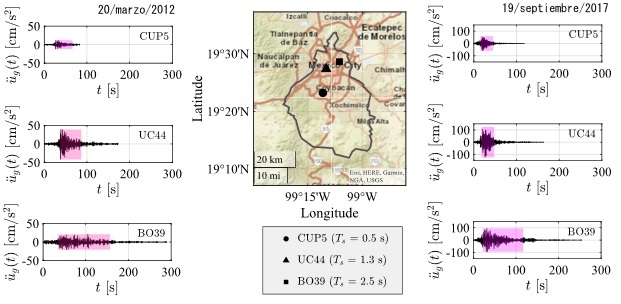
An analysis of the accelerograms defined in the Mexico City Technical Design Standards (NTC) is presented. The study is based on probabilistic seismic hazard analysis, hazard-consistent ground-motion simulation, and comparison with the accelerograms provided in NTC-2023. The results indicate that these accelerograms do not meet the intensity demands associated with ground-motion duration, leading to biased estimates of the inelastic structural response. Displacement and hysteretic energy response spectra are presented for three sites in Mexico City, analyzing single-degree-of-freedom systems modeled with a bilinear constitutive law. In addition, the temporal evolution of the characteristic site period is analyzed using exponential models, highlighting its influence on the expected duration of strong ground motion and its impact on duration-based hazard curves. It is recommended that the models used to estimate the ground-motion parameters involved in the characterization of the NTC accelerograms be continuously updated.
Downloads
References
American Society of Civil Engineers (ASCE) (2022) Minimum Design Loads and Associated Criteria for Buildings and Other Structures. American Society of Civil Engineers, Reston, Virginia
Arias A (1970) A measure of earthquake intensity. In: Hansen RJ (ed) Seismic Design for Nuclear Power Plants. MIT Press, Cambridge, Massachusetts, pp 438–483
Arroyo D, Ordaz M, Ovando-Shelley E, et al (2013) Evaluation of the change in dominant periods in the lake-bed zone of Mexico City produced by ground subsidence through the use of site amplification factors. Soil Dyn Earthq Eng 44:54–66. https://doi.org/10.1016/j.soildyn.2012.08.009
Bates DM, Watts DG (1988) Nonlinear Regression Analysis and Its Applications. John Wiley & Sons, Inc
Bommer JJ, Martínez-Pereira A (1999) The effective duration of earthquake strong motion. J Earthq Eng 3:127–172. https://doi.org/10.1080/13632469909350343
Demidenko E (2004) Mixed Models: Theory and Applications. John Wiley and Sons, Inc, New Jersey
Douglas J (2022) Ground motion prediction equations 1964-2021. Glasgow, UK
European Committee for Standardization (CEN) (2010) Eurocode 8: Design of Structures for Earthquake Resistance - Part 1: General Rules, Seismic Actions and Rules for Buildings. London
García D, Singh SK, Herráiz M, et al (2005) Inslab earthquakes of central Mexico: peak ground-Motion parameters and response spectra. Bull Seismol Soc Am 95:2272–2282. https://doi.org/10.1785/0120050072
Gasparini DA, Vanmarcke EH (1976) SIMQKE: A program for artificial motion generation. User’s manual and documentation. M.I.T. Department of Civil Engineering, Cambridge, Massachusetts
Huang Y-N, Whittaker AS, Luco N, Hamburger RO (2011) Scaling earthquake ground motions for performance-based assessment of buildings. J Struct Eng 137:311–321. https://doi.org/10.1061/(ASCE)ST.1943-541X.0000155
Jaimes MÁ, García-Soto AD, Candia G (2024) Horizontal and vertical ground-motion duration prediction models from interplate and intermediate-depth intraslab earthquakes in Mexico City. Bull Seismol Soc Am. https://doi.org/10.1785/0120230153
Jaimes MÁ, Reinoso E (2006) Comparación del comportamiento de edificios en el Valle de México ante sismos de subducción y de falla normal. Rev Ing Sísmica 75:1–22
Kramer SL (1996) Geotechnical Earthquake Engineering. Prentice Hall, Upper Saddle River, New Jersey
López-Castañeda AS (2022) Evaluation of strong-motion duration as design parameter in earthquake engineering. Universidad Nacional Autónoma de México
López-Castañeda AS, Martín del Campo JO, Reinoso E (2024a) Amplitude and duration hazard‑consistent ground‑motion selection for seismic risk assessment in Mexico City. Bull Earthq Eng. https://doi.org/10.1007/s10518-024-01976-z
López-Castañeda AS, Martín del Campo JO, Reinoso E (2024b) Seismic hazard study for the duration of ground‑motions triggered by intraslab earthquakes. Nat Hazards. https://doi.org/10.1007/s11069-024-06682-2
López-Castañeda AS, Reinoso E (2021) Strong-motion duration predictive models from subduction interface earthquakes recorded in the hill zone of the Valley of Mexico. Soil Dyn Earthq Eng 144:106676. https://doi.org/10.1016/j.soildyn.2021.106676
López-Castañeda AS, Reinoso E (2022) Significant duration predictive models developed from strong-motion data of thrust faulting earthquakes recorded in Mexico City. Earthq Eng Struct Dyn 51:129–152. https://doi.org/10.1002/eqe.3559
López-Castañeda AS, Reinoso E, Martín del Campo JO (2022) Influence of site-specific strong-motion duration on structural performance. Bull Earthq Eng 20:7047–7075. https://doi.org/10.1007/s10518-022-01499-5
Montalvo-Arrieta JC, Reinoso E, Sánchez-Sesma FJ (2003) Observations of strong motion at hill sites in Mexico City from recent earthquakes. Geofísica Int 42:205–217
NEHRP Consultants Joint Venture, National Institute of Standards and Technology (NIST) (2011) Selecting and Scaling Earthquake Ground Motions for Performing Response-Hisotry Analyses (NIST GCR 11-917-15)
Pinheiro JC, Bates DM (2000) Mixed-Effects Models in S and S-Plus. Springer-Verlag, New York
Secretaria de Obras y Servicios de la Ciudad de México (SOS-CDMX) (2023) Normas Técnicas Complementarias para Diseño por Sismo. In: Reglamento de Construcciones para el Distrito Federal. Mexico City
Singh SK, Ordaz M, Pérez-Campos X, Iglesias A (2015) Intraslab versus interplate earthquakes as recorded in Mexico City: Implications for seismic hazard. Earthq Spectra 31:795–812. https://doi.org/10.1193/110612EQS324M
Downloads

Published
How to Cite
Issue
Section
License
Copyright (c) 2026 Journal Earthquake Engineering

This work is licensed under a Creative Commons Attribution-NonCommercial 4.0 International License.